
Homeownership: Family Benefit
Homeownership: Family Benefit
Operating in the moral grey area is a tough spot to be. That is where I was operating as I watched interest rates rise. My job is to be a fiduciary for my clients throughout the home-buying and selling process. What does that mean? I have to put my client’s interest above my own. For a textbook overthinker like myself, that started to become ethically grey as interest rates rose. Clients would engage me to help them purchase a home, while in the back of my mind, I am thinking, “Is this going to be a massive mistake for them?” With payments at all-time highs and rates higher than they had been, I truly started to wonder if buying a home in this market is a good idea.
Several experiences pushed that wonder more into the realm of doubt when more short sales started happening, and I even had one client, who I had recently sold a home to, start to miss their mortgage payments. Ethically, what was I to do? If I truly put my client’s interest above my own, wouldn’t I beg them not to purchase the home?
Finally, I looked at the data and found that owning a home is one of the single most important actions someone can take to better their future and the future of their children, rates aside. Below are three areas I researched and the surprising results in each of these categories as it relates to homeownership.
Children’s Education & Behavior
According to Habitat for Humanity, high school graduation rates in children coming from families who own a home are 19% higher than the children whose families rent their home. I understand that high school graduation is not the perfect barometer for success, but it does give us a window into the momentum that homeownership gives to young people. The study goes on to say that children from ownership families are twice as likely to acquire some postsecondary education as those who come from renting families. The second metric widens the window and allows us to see that momentum carries forward beyond the years the students are actually in their parents’ household.
A study performed by Harvard found that students whose family owns a home scored higher on math and reading tests. Additionally, behavioral issues were less common when the child lived in a home that was owned by their family. The behavioral benefits don’t stop there, however. The Harvard study also says that parental homeownership reduces the chances of teenage pregnancy in the owner’s children.
These studies were performed by some of the top researchers in the world and found that owning a home can increase graduation rates, improve test scores, lower teenage pregnancy rates, and increase behavioral quality in children. Those are real-life benefits with incredibly high impact!
I understand the argument that some of these benefits may not be directly caused by owning a home, but hang with me, because the list of benefits of owning continues to grow the further we go. And sooner or later, it must be recognized that the common thread here is homeownership.
Physical Health
Homeownership can reduce the chances of major chronic health issues. This surprised me. I am an accountant by training and have always considered the financial side of real estate, but according to a study published by the CDC in 2024, substantial data show that Americans who own homes are subject to lower rates of heart disease, strokes, diabetes, asthma, and kidney problems. In some cases studied by the CDC, renters were almost twice as likely to have serious illnesses like strokes. Below is a graph illustrating the results of the study:
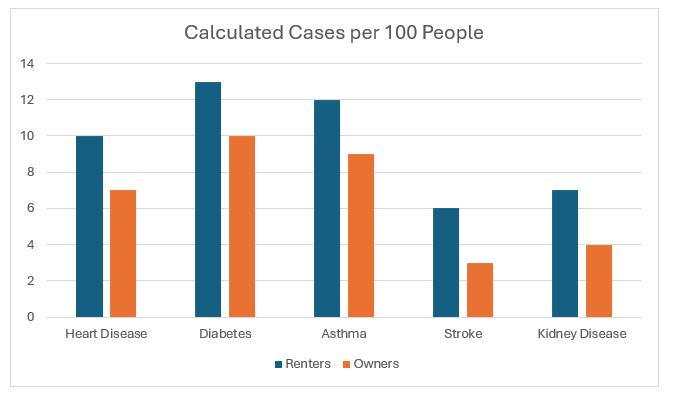
These findings are startling. Especially when it comes to kidney disease and strokes. In every category, homeowners were less likely to have those diseases.
The correlation between homeownership and physical health was not apparent to me at first. So, like you might be right now, I wondered how this correlation exists. The study ultimately suggests that renters have more stress in their lives. They attributed the healthier homeownership group to more stability in their household and more stability in the neighborhoods around them. Additionally, renters were forced to move more often than homeowners, which resulted in heightened stress levels in renters.
The results of this study surprised me, alarmed me, even.
Physical health benefits were surprising to me. I did not anticipate that there would be as many health benefits to owning a home. The next study, and its results, were much more intuitive to me, but equally as startling.
Generational Poverty
I have long had the assumption that subsidized housing is a crutch that is detrimental to the generational wealth building of low-income families. This idea is straightforward: if families have cheap or free monthly housing, there is no incentive to better their lives. The argument for subsidized housing is that it helps people by taking one of the larger financial burdens off the table, which then allows them to save money and eventually better their lives. Unfortunately, the data show that lower-income families are very unlikely to “save their way out” of poverty.
A study performed by two university researchers and published on huduser.gov shows that low-income families who purchased a home had relatively significant wealth accumulation over the ten years of the study. Meanwhile, their renter counterparts accumulated zero wealth. The study says, “In terms of lower income households, non-housing wealth accumulation is at best minor and, for minority families, often negative.” This is heartbreaking! If low-income families don’t buy a home, they will be no better off financially in ten years than they are right now, and in many cases, they will be worse off.
Generational wealth for low-income families is nearly impossible to create without the purchase of a home. Buying a home forces the purchaser to save money each month through paying principal and reap the appreciation of the home itself. One objection I often hear is the idea that low-income neighborhoods don’t appreciate; this is untrue. I personally have a client who purchases homes in the worst neighborhoods of Camden, NJ, and has been doing so for almost a decade.

A home in Camden, NJ
He, like most people around the country, has seen double-digit appreciation percentages in just a few years. This demonstrates that those who purchase, even in low-income neighborhoods, still fare better than those who rent. This point is doubly compounded due to the fact that, in many low-income neighborhoods, rent is higher than a mortgage payment.
Renting, especially for low-income families, is one of the easiest ways to guarantee your net wealth will be the same, or less, in ten years.
The benefits of homeownership are not limited to the list in this study, nor am I saying that there are no downsides to buying a home. However, the research is far-reaching and in nearly every case, came back with the same claim, “Buy a house!” There are other things you can do to increase your child’s success in school, decrease your chances of a stroke, or help contribute to your family’s generational wealth, but finding one thing that does all of those would be difficult.
For me, this was a great study. I can help my clients buy homes knowing I am not operating in a moral grey area. I am firmly on the right side of the black and white. Knowing the profound impact owning a home can have on the family, I can guide my clients through the home-buying process, knowing they and their children will reap the invaluable benefits for years to come.
Source Links:
Boehm, T. P., & Schlottmann, A. M. (2008). Wealth accumulation and homeownership: Evidence for low-income households. U.S. Department of Housing and Urban Development.
https://www.huduser.gov/publications/pdf/wealthaccumulationandhomeownership.pdf
Habitat for Humanity Northwest New Jersey. (n.d.). Homeownership’s impacts.
https://habitatnwnj.org/homeownership/homeownerships-impacts/
Li, W. (2001). The impact of homeownership on child outcomes. Harvard Joint Center for Housing Studies.
https://www.jchs.harvard.edu/sites/default/files/media/imp/liho01-14.pdf
Rahman, S., & Steeb, D. (2024). Homeownership matters: Impact of homeownership on the prevalence of chronic health conditions in the United States. Preventing Chronic Disease, 21, Article E33.
https://doi.org/10.5888/pcd21.230324
